
Search has shifted under your feet while you were busy trying to keep your pipeline full. You feel it every time you open Google or talk to your team about traffic drops that do not make sense on paper. Yet your buyers are still finding answers somewhere.
That “somewhere” is what Answer Engine Optimization is all about. If you ignore it, your brand starts fading from the conversation long before traffic reports show a red arrow. Answer Engine Optimization is how you keep your brand visible inside AI-generated answers, not just in a long list of blue links.
You’re missing a massive opportunity if you only focus on traditional rankings. The search share for AI-driven platforms is growing rapidly, changing how users interact with the web.
Table Of Contents:
- Answer Engine Optimization (AEO): The Future of SEO in the AI Era
- From Search Engines to Answer Engines
- So What Exactly is Answer Engine Optimization?
- SEO vs. AEO
- How Buyer Behavior is Quietly Shifting Under Your Strategy
- Core Principles of an Answer Engine Optimization Strategy
- What This Means for Your Marketing Strategy
- How to Make Your Content AEO-Ready
- Conclusion
Answer Engine Optimization (AEO): The Future of SEO in the AI Era
Let’s start with the hard truth you already feel in your analytics. Google is giving people answers without sending them to your site. The percentage of zero-click Google searches jumped from 56 percent in 2024 to 69 percent in 2025.
This means most searches end on the results page. Your perfect blog post can appear, do the work, and never get a click. It hurts, but it is real.
And this is before you factor in how much behavior is shifting to AI tools directly. ChatGPT alone now serves about 800 million weekly users. OpenAI products reach over 400 million people each week.
Bing’s mobile app downloads jumped by 10 times after it introduced AI chat features, according to reporting from TechCrunch. This is no longer about one search box on one search engine. Your buyers now ask questions across Google, ChatGPT, voice assistants, and tools embedded in devices you never see.
Gartner predicts that by 2026, a quarter of organic search traffic will shift to AI chatbots and virtual agents. That does not mean people stop searching. It means the “page of links” is no longer the only stop on the journey.
These changes demand a new approach to digital marketing. If you rely solely on website traffic from standard queries, your digital visibility will suffer.
From Search Engines to Answer Engines
For years, your job was simple on paper. Pick keywords, invest in engine optimization, build authority, and hope for the top spot. The model looked like this:
| Old Search Engines | New Answer Engines |
|---|---|
| Show ten blue links | Give a direct, conversational answer |
| Focus on keyword matches | Focus on intent and context |
| Rely on a click to share info | Surface a summary right on the screen |
| Reward individual pages | Reward trusted, clearly structured sources |
Google says that 15 percent of daily searches are brand new. Many of these are natural language questions people have never typed before.
A buyer might no longer search for “best email marketing software” as a short phrase.
Instead, they say things like “which email marketing software works best for a retirement community?”
Or they might ask, “what’s the best CRM for a small team to keep track of leads and costs less than one hundred per month?”
These are long-tail queries that require precise, contextual responses.
Answer engines look at a mix of signals, gather facts, and generate one unified answer that tries to settle that question on one screen. They use machine learning to synthesize information from multiple sources. If your content is not part of the knowledge they pull from, your brand disappears.
You vanish from the conversation even while your traditional rankings look decent on paper. You need to provide direct information that easy AI systems can digest.

So What Exactly is Answer Engine Optimization?
Answer Engine Optimization (AEO) is the practice of shaping your content so that AI-driven tools can easily find it, trust it, and quote it. AI systems use this content in the answers they show to users.
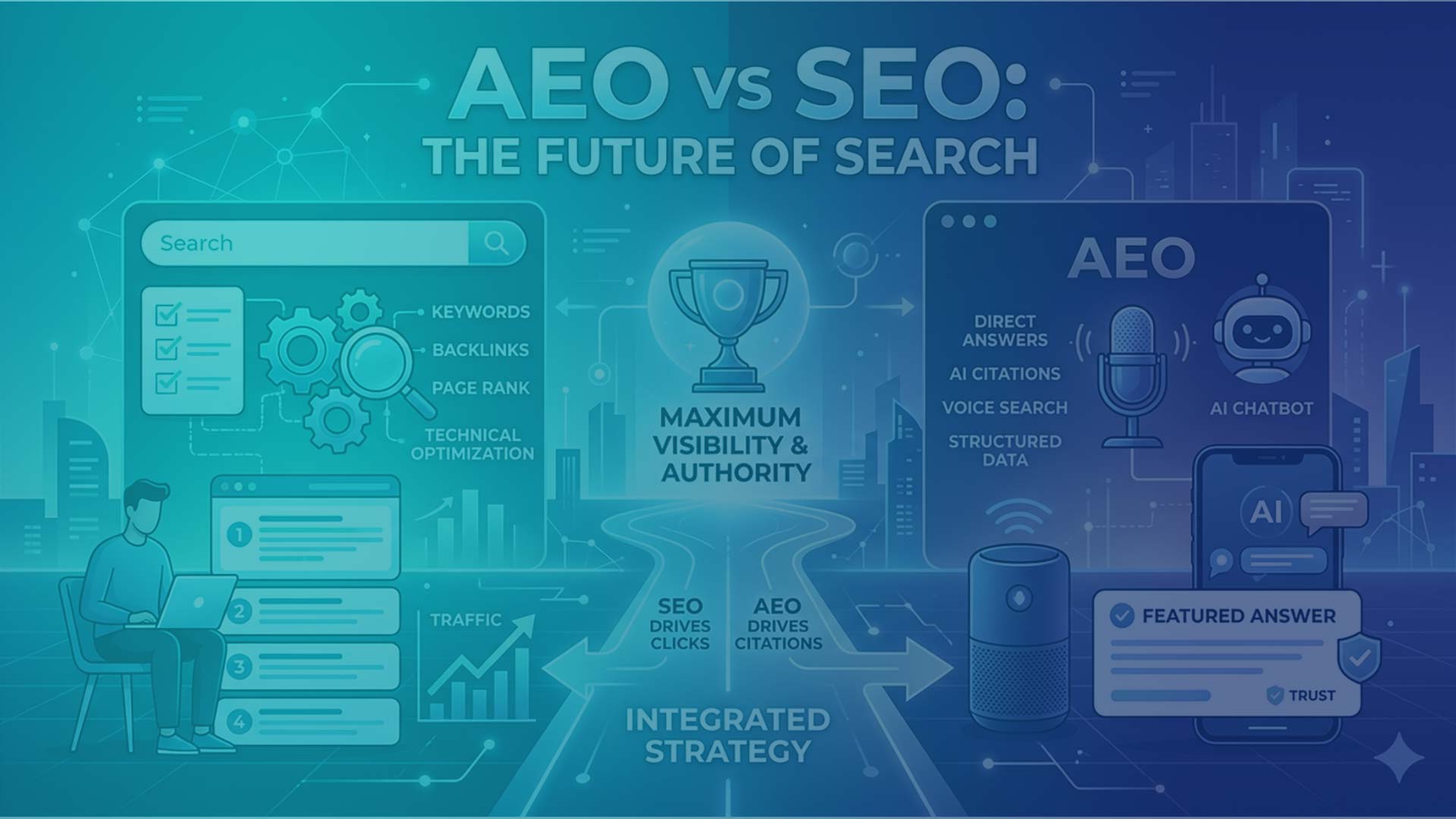
Traditional SEO tries to move pages up the list of links. AEO tries to make your brand the actual answer those links are based on.
You are not only asking “how do we rank for this keyword?” You start asking “how do we become the safest, clearest answer this system can pick up?”
It shifts the game from pure traffic to influence. You move from chasing pageviews to being mentioned in the summary that people actually read.
That is not just theory. One study found that 99 percent of URLs shown in AI modes are already in the top 10 organic results. Strong search engine optimization is still your foundation. However, AEO is how you convert that strength into answer visibility.
By optimizing content for AI-driven search, you increase the likelihood of becoming a cited answer. This improves your brand mentions and authority in an AI-first world.
SEO vs. AEO
You do not have to choose one over the other. You just need to know how they work together, because they serve different parts of the journey. Both are vital for a complete content strategy.
| Traditional SEO | Answer Engine Optimization |
|---|---|
| Optimizes for short and mid-length keywords | Optimizes for full questions and long phrases |
| Aims to rank pages higher | Aims to appear in summaries and citations |
| Focus on traffic and clicks | Focus on visibility inside answers |
| Uses title tags and meta descriptions heavily | Relies on clean structure, clear sections, and facts |
Think of SEO as your ticket into the top-tier results. Then AEO decides if you get quoted by the AI sitting on top of that pile. You need both, because the search box still matters.
Google still held around 89.6 percent global market share for search at the end of 2024. But newer tools like ChatGPT search have grown fast. They saw a 740 percent market share jump in twelve months.
You are now dealing with an ecosystem, not a single platform. Traditional search engines and AI search platforms must both be considered. It is about total online visibility.
How Buyer Behavior is Quietly Shifting Under Your Strategy
To really understand why AEO matters, it helps to watch where attention has moved.
Consider developers, who used to live inside Stack Overflow for answers. After AI tools arrived, that site saw a 14 percent drop in visits in 2022. Users started getting code snippets directly from chatbots instead of threads.
On the other hand, financial brands like NerdWallet leaned into being the source inside AI driven answers. They reported 21 percent revenue growth while monthly traffic fell 20 percent. That is what influence over the answer looks like, even when you lose clicks on paper.
You also cannot ignore voice assistants. Voice commerce is expected to hit about $80 billion in yearly value.
There were about 8.4 billion digital voice assistants in use in 2025. Every one of those assistants pulls some kind of “answer” from structured sources. This happens when someone asks for directions, recommendations, or quick facts.
At the same time, more than half of searches do not end in a click. Wordtracker estimates that nearly 60 percent of searches go nowhere. Your content may already be influencing those decisions without ever getting a neat visit credited in your dashboard.
You must optimize content for conversational questions to satisfy user needs in this environment.

Core Principles of an Answer Engine Optimization Strategy
You might be wondering, how do we actually adjust our content for this new landscape without burning down what already works?
There are a few core ideas that make AEO practical instead of abstract. Following these AEO strategies helps you satisfy user intent effectively.
1. Write to Real Questions, Not Just Keywords
Your buyers do not speak in tidy key phrases. They type exactly what is in their heads and expect machines to sort it out. You need to hear and reflect that language across your site.
Use question-focused research tools like Answer the Public, BuzzSumo Question Analyzer, or similar platforms. This helps you see what your market is asking in their own words.
Look for patterns, concerns, and “versus” style searches where buyers weigh options. Then build content that mirrors those questions.
Here is a simple pattern to follow:
- Create H2 and H3 headings that are phrased as conversational questions.
- Answer directly in one to three sentences right below each heading.
- Expand with short paragraphs, bullets, or tables under that quick answer.
This mirrors how AI systems prefer to scan and pull content. It also helps people, which is the point. Understand user intent and deliver precisely what is asked.
2. Put The Answer First, Then Add Depth
A lot of older SEO advice pushed long introductions that eased into the point. That slows people down, and it confuses answer engines. They are looking for clean, direct responses they can lift and quote.
A simple pattern that works well looks like this:
- State the question clearly in a heading.
- Give a direct, plain language answer in two short sentences.
- Only then unpack the reasoning, context, or nuance.
This type of structure matches best practices shared by AEO guides. Write one- to three-sentence paragraphs and lean on bullets and tables.
Clean edges help both the robot and the rushed human skimmer. This format is essential for appearing in a featured snippet or AI overview.
3. Make Your Structure Machine-Friendly
You do not have to write like a robot for robots to read you. You just need predictable patterns. Think about your page like a well-outlined book chapter.
- Use H2 sections to group major ideas or stages.
- Use H3 headings to cover subquestions and edge cases.
- Break out lists of steps, signs, or benefits with HTML lists.
- Use tables for side-by-side comparisons, pricing, or specs.
Google’s Knowledge Graph relies on structured, trusted sources to assemble direct answers. The easier your content is to parse and label, the more likely it becomes part of those background graphs. Your content format plays a huge role in AI visibility.
4. Lean Into Structured Data Without Chasing Tricks
Schema markup is not magic, but it is helpful scaffolding.
In 2019, Schema.org added dedicated FAQ, How to, and Q and A types. Those formats make it clearer that “this part is a question” and “this line is the answer.”
Research from Moz shows that classic featured snippets have declined. But that does not mean structure stopped mattering. Schema is still useful for rich results, carousels, and how future answer engines interpret your content.
You can start with the basics:
- Add an FAQ schema to pages that already have genuine question and answer sections.
- Use Article schema for deep guides and editorial pieces.
- Layer on a Product or Review schema if you sell and collect reviews.
You do not have to get fancy with every property from Schema.org. Just make sure the meaning of your content is clear, consistent, and accurate. You might even use a Chrome extension to validate your schema quickly.
5. Build Topical Authority, Not Just One-Hit Pages
Answer engines prefer sources that “own” a topic rather than single posts that dabble. This lines up with broader research on AI results and authority.
The brands that win have a strong base of topical depth. Practically, that means creating clusters instead of random, standalone posts.
For a topic like Answer Engine Optimization, that could look like this list of assets:
- An overview explainer on what AEO is and why it matters.
- A comparison of AEO and classic SEO strategy.
- A step-by-step implementation guide for your industry.
- Case stories that show influence even with flat traffic.
- A playbook for AEO and voice search for your location-based services.
This approach shows both search engines and answer engines that you have serious depth. It proves you are not just sharing a surface opinion. Trust signals like this are crucial for technical SEO.
6. Measure More Than Just Clicks
This is the part many teams skip, because the old reports feel easier and familiar. Yet AEO performance shows up in more places than traffic charts.
Start looking at things like:
- Brand mentions and quotes inside AI tools during live tests.
- Changes in assisted conversions or “direct” sales while traffic is flat.
- Lead source comments where buyers say they “saw your advice” without a clear page path.
- Increase organic impressions that do not result in clicks.
You should measure citations directly, not just rankings. Rankings alone cannot predict AI visibility anymore.
What This Means for Your Marketing Strategy
So what do you do with all this when you already have a content backlog? You have campaigns to run and a team that feels stretched.
You do not toss classic search engine optimization out the window. You add a new layer to the work you are already doing. Your website content needs to evolve.
Here is a simple way to phase in an Answer Engine Optimization strategy without burning your team out:
- Pick your top three to five money topics or services.
- Audit current content on those topics for structure and clarity.
- Rewrite key sections into question-and-answer patterns with clean headings.
- Add a basic FAQ or How to schema where it fits.
- Test AI tools with your main questions and watch who they quote.
- Fill the gaps with new supporting articles that deepen your coverage.
As you work on these, you can keep leaning on solid partners for foundational engine optimization. This helps you maintain and grow visibility in classic results.
Connecting with teams focused on engine optimization for regional brands can also be beneficial. As AI-driven search spreads, this blend of classic SEO plus AEO gives you staying power.
This is not just for short-term spikes. It is about targeting keywords and intent simultaneously. This ensures you satisfy user needs across all platforms.
How to Make Your Content AEO-Ready
If you want a simple checklist you can work through with your content team, use this as a starting framework. You can adapt it to fit your industry, offer, and capacity. This works well for primary content and blog posts.
Step 1: Choose The Right Page to Start With
Do not try to optimize everything at once. Pick one core page that lines up with a critical question your buyer always asks. This is often a main service page or your highest intent blog post.
Look for pages that already pull in some traffic. Pages ranking in the top 20 results for important keywords are prime candidates. Those have a higher chance of getting surfaced in answer engines once the content is tuned.
Step 2: Rewrite for Questions and Clarity
Scan your headings and copy and ask yourself three blunt questions:
- Where are the real buyer questions in this text?
- Is there a clean two-sentence answer anywhere near each one?
- Would a skimmer know what this page is about in under 30 seconds?
If the answers are muddy, restructure the page. Turn loose phrases into explicit questions. Place concise answers, free of fluff, immediately below each one.
Step 3: Tighten Paragraphs and Add Lists
Answer engines prefer text they can cut cleanly. That means tight paragraphs and predictable breaks. A useful rule is to stick to one- to three-sentence paragraphs.
You should also use bullet lists for clear steps. You are reading that pattern right now. It makes scanning easy for both people and machines.
Step 4: Add a Schema Where It Helps Understanding
Once the text is in good shape, layer in structured data. Start with an FAQ markup if your page contains genuine Q and A sections. You can expand later into more complex schemas as needed.
Validate your markup with tools linked from Google’s structured data documentation. Do not stress about perfection on day one. The goal is to help search systems understand the type of content and its purpose.
Step 5: Test in Real Answer Engines
After publishing updates, act like your own buyer. Go to Google, Bing, ChatGPT, and other AI tools. Ask the same questions you optimized for.
Watch who shows up and who gets quoted. This helps you understand your AI visibility. This gives you two things:
- A realistic sense of the competitive landscape for that question.
- New ideas for supporting content that your market expects.
Over time, document which of your pages seem to feed these answers. Do this even if the visits are labeled oddly in analytics. This is where AEO starts to feel real instead of abstract.
User engagement with AI tools is harder to track but essential to monitor. Check referral traffic sources carefully for anomalies.
Conclusion
Search is not dying. It is splintering.
Your buyers still have the same questions, fears, and hopes. But now they whisper those questions to AI chatbots, voice assistants, and answer engines.
These systems sit between you and the click. If you keep planning content only for 10 blue links, you miss where decisions are actually made.
Answer Engine Optimization is how you bring your brand into that hidden conversation. It builds on classic engine optimization, but it shifts your goal from pure rankings to being the most trustworthy, quotable answer in the mix.
That is how you stay visible as zero-click searches rise.
AI usage explodes, and traditional search volume declines. Marketing that lasts is marketing that adapts to how people really look for help. Right now, that means tightening your structure and writing directly to answer questions.
You must invest in authority and think of visibility as influence, not just clicks. If you can do that, Answer Engine Optimization stops feeling like yet another buzzword. It starts becoming a quiet edge that compounds for your brand over time.